

By Deacon Timothy Siburg
Revised Common Lectionary reflection for Proper 21, Year C
September 28, 2025
Based on Luke 16:19-31; 1 Timothy 6:6-19; Amos 6:1a, 4-7; and Psalm 146.
Key Verse: “Child, remember that during your lifetime you received your good things and Lazarus in like manner evil things, but now he is comforted here, and you are in agony,” -Luke 16:25
There are good weeks to preach on stewardship, and then there are great weeks to preach on stewardship. This might be one of the greatest weeks for stewardship preaching and teaching in the revised common lectionary. Back when I was in college, one of my favorite classes was called “Wealth and Poverty in the Ancient Church.” In that class we read St. John Chrysostom’s On Wealth and Poverty, a compilation of six sermons with implications for daily life, discipleship, neighbor love and stewardship all centered on Luke 16:19-31.
Jesus had a thing or two to say about wealth, poverty, and possessions. In fact, based on some counts, Jesus talks about these themes second only to the Kingdom of God/Kingdom of Heaven. In particular, Luke’s themes and stories of justice, caring for neighbor and stewardship have been coming in abundance of late in the Lectionary, and they continue this week with a story about a poor man named Lazarus and an unnamed rich man. This is a story from Jesus that we know well.
This gospel story always gets me. Am I paying attention to my neighbor’s needs? Do I do my best to meet them where they are? Or do I do avoid them so that I and my immediate family might be comfortable? Do I care about some neighbors more than others?
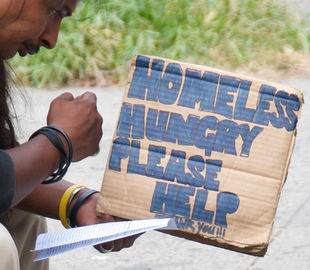
On the one hand, we have Lazarus desperately in need and not cared for. He may have been the stereotypical corner beggar or the homeless individual whom we all might avoid by crossing the street – or at the very least avoid making eye contact with. On the other, we have a rich man who has all he needs; and probably way more. Yet, for whatever reason, he doesn’t show compassion and mercy for Lazarus. They are neighbors, but the rich man makes no effort towards Lazarus.
Flash forward. Both have died, and the roles have reversed. The rich man cries out to Abraham and Lazarus for help. Abraham responds, “Child, remember that during your lifetime you received your good things and Lazarus in like manner evil things, but now he is comforted here, and you are in agony” (Luke 16:25). Perhaps there is no clearer story in the gospels of the great reversal that comes with God’s Kingdom.
Caring for our neighbor in daily life matters. So how are we doing at caring for neighbors and closing the gap between the haves and have nots? The latest report from the World Bank raises red flags and warnings. The World Bank says about 700 million people (8 percent of the world’s population) live in “extreme poverty,” on less $2.15 per day. Additionally, about 3.5 billion (44 percent) “remain poor,” living on no more than $6.85 a day. We have a long way to go to close the chasms between the rich and poor.
If you are like me, you might be looking for a silver lining or a way to let ourselves off the hook. We might claim that we are just “middle class,” and not “rich.” But if we are being honest with God and ourselves, we must acknowledge we are likely very rich globally. What might that mean for us? How might God be inviting us to respond?
Three reactions we might ponder:
- Confess and call a thing what it is. We are rich with what God provides, and God provides abundantly. But that doesn’t mean that everyone has what they need. Across the world, many of our neighbors need help in receiving their daily bread (as we pray in the Lord’s Prayer). As God provides abundantly, God calls to care for our neighbor and be so moved by them that we respond to their needs. When we don’t, the words of Amos move us from complacency: “Woe to those who are at ease…” (Amos 6:1)
- Take hold of the life that really is life. Does the gospel move us and change us? Does this parable? In Jesus’ story, the rich man pleads for Abraham to sends Lazarus to warn his brothers. Abraham replies, “If they do not listen to Moses and the prophets, neither will they be convinced even if someone rises from the dead” (Luke 16:31). This appears to be a passion prediction within a parable, and it’s a fair question to us. Does the good news of Jesus’ life, death, resurrection, and ascension matter to us and transform us? Or do we live unchanged? If we are changed, we will follow the advice of the writer of 1 Timothy to “take hold of the life that really is life” and to grow, serve, and share as disciples and stewards of God’s love (1 Timothy 6:19)?
- Respond and join in with God. The good news is that through God, death no longer has the final word. This is true for Lazarus, and its true for all of God’s beloved. But what we do matters. Do we hoard what God provides and fall victim to the allure of money, power, and wealth (as 1 Timothy 6:9-10 warns)? Or do we live changed, following the example of our God, “who executes justice for the oppressed; who gives food to the hungry, sets the prisoners free… watches over strangers, upholds the orphan and the widow” (Psalm 146:7-9)? God entrusts and provides, and God does so abundantly. How will we respond? How will we join in with some of God’s on-going work as outlined in Psalm 146 today?
At the very least, may we not be at ease with the way things are. May we be moved to not only see our neighbors where they are at, but to meet with them with a hand up and our full selves. May God’s love be made real, in part through us for the sake of our neighbors.
In Worship and Congregational Life
A new-to-me song, originally written in Portuguese, has gotten stuck in my mind and heart of late. It’s called, “For the Troubles and the Sufferings,” or “Pelas dores deste mundo,” as originally written by Rodolfo Gaede Neto. It’s a beautiful and powerful setting for prayer, lament, and kyrie, and I have been working to teach my home congregation this song. Consider its text: “For the troubles and the sufferings of the world, God, we call upon your mercy: the whole creation’s laboring in pain! Lend an ear to the rising cry for help from oppressed and hopeless people: Come! Hasten your salvation, healing love! We pray for peace, the blessed peace that comes from making justice, to cover and embrace us. Have mercy, Lord! We pray for power, the power that will sustain your people’s witness: until your kingdom comes. Kyrie eleison!”
Imagine Lazarus’ cries that go unheeded by the rich man. This song names them and lifts them up in a way that can move anyone. Perhaps it might be a meaningful piece to include in your community’s worship. [This song can be found in All Creation Sings, (Minneapolis, MN: Augsburg Fortress, 2020), 1051.]
Does your congregation have a feeding ministry or community outreach? Perhaps after hearing this story your church could expand or begin a meals ministry, such as putting together sandwiches and meals for those in need. These are just first steps of doing something tangible. What more might it look like to come alongside and grow into relationship with one another?
With Youth and Children
Surely, your community has needy neighbors, some of whom can be seen begging on the streets. Others may be found in shelters or food banks or community kitchens. Who are they, and what are tangible ways to provide for their needs? This would make a good opening question for a time with youth and children. What do they see in their schools? Does your congregation have a weekend backpack ministry, where food is sent home on Friday to help feed the families of needy schoolchildren? If so, a “show and tell” session with a backpack would go a long way.
An honest discussion with youth and children could lead the congregation into deeper resolve and action to help meet their neighbors where they are and to work to some of God’s kin-dom building work of reconciliation and forming beloved community.
Previous reflections for Proper 21C:
2019 – When it comes to money, it’s all about the attitude
2016 – Take hold of real life
2013 – True wealth
2010 – The connection between money and happiness




Leave a Reply