

By Deacon Timothy Siburg
Revised Common Lectionary reflection, Reign of Christ Sunday
November 23, 2025
Key Verse: “May you be made strong with all the strength that comes from his glorious power, so that you may have all endurance and patience, joyfully giving thanks to the Father, who has enabledyouto share in the inheritance of the saints in the light” -Colossians 1:11-12.
Here we are at a threshold and transition moment. Christ the King/Reign of Christ Sunday marks the end of the liturgical year, an end this year in our journey largely through the Gospel of Luke in Year C. Next week we begin again with Year A, and the start of Advent. So, we find ourselves in a transition moment. Where the gospel story we know so well comes full circle. Yet, perhaps it feels all the more poignant this year, given all that seems to be transpiring around us and within us.
The gospel story for this last liturgical day takes us, fittingly, to the cross. To the presumed end of the story, but in its own way, really the beginning of our story. We hear Jesus say, “Father, forgive them, for they do not know what they are doing” (Luke 23:34). Even amid the darkness of Good Friday, the darkness of hopelessness, death, and fear, Jesus shows a different way to live. One where care and concern are embodied through compassion, reconciliation, and forgiveness. This is the kind of kingdom and kin-dom sort of work that Jesus was called to point to and proclaim. Not the kind with kings found in fairy tales or of those who might be wanting oligarchs, dictators, or all-powerful emperors. God’s kingdom is something different than what is often held up as “king” in our earthly world. Rather, this kingdom is one where God’s people love God and love their neighbors as themselves. This kingdom is one of reconciliation, mutual support and care, and one that is grounded in love. It’s not one of transaction or “what have you done for me lately” decision making. Rather, it’s one grounded in life-long relationships with and for one another.
On the cross next to Jesus, a criminal asks and rebukes another, “Do you not fear God, since you are under the same sentence of condemnation? And we indeed have been condemned justly, for we are getting what we deserve for our deeds, but this man has done nothing wrong” (Luke 23:40-41). In the way of the world and the kingdoms of this earth, death and punishment would be final. But God offers another way. Death is not the final word. The cross is not the end of the story. As the one who said to Jesus, “Jesus, remember me when you come into your kingdom,” Jesus says in response to him and to us, “Truly I tell you, today you will be with me in paradise” (Luke 23:42-43). Jesus is pointing to another way. Jesus is showing through his last breaths what it truly means to be a king. To be a servant. To be one who loves and cares for one’s neighbor. To lead by showing and embodying love, mercy, and compassion. This is why we celebrate Christ the King Sunday. Because this is the life we are all called into as disciples and stewards.
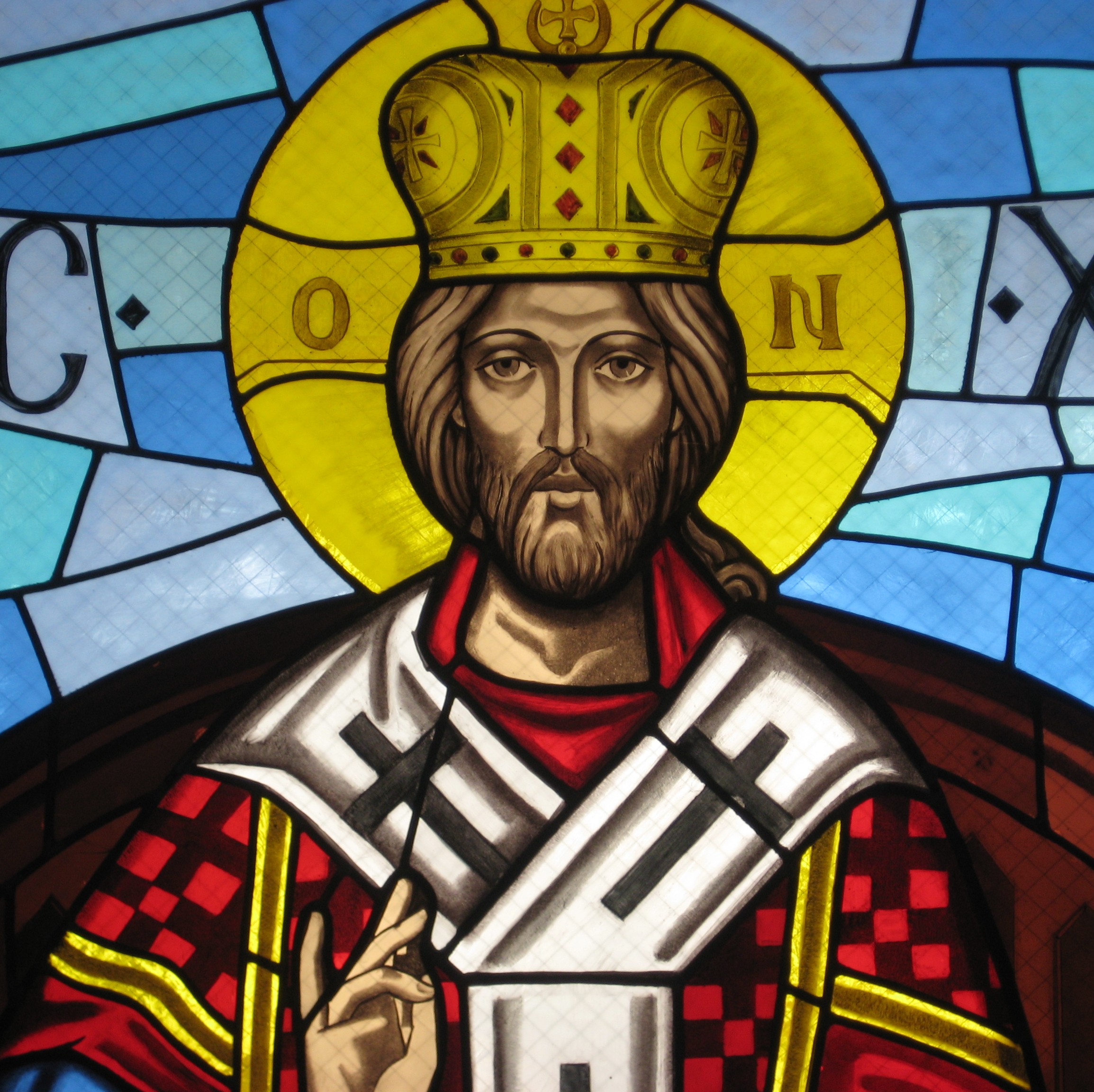
Jesus reigns as king. For this we rightfully celebrate and give thanks. Even if we feel that giving thanks is a difficult proposition right now. Perhaps we feel that the world is in an uproar. Perhaps the ground beneath our very feet feels unstable. All most certainly may not be well. But as the psalmist proclaims, “Be still and know that I am God; I will be exalted among the nations; I will be exalted in the earth” (Psalm 46:10). Despite all that might be going on in, around, and within us, we are invited to breathe deeply. To pause. To ponder. To witness again God’s saving work for you and for me. To remember who we are, and whose we are. At its best, the themes of Christ the King Sunday help us do this, as we look back on our journey this liturgical year, and look forward to beginning anew next week.
The prophet Jeremiah proclaims, “The days are surely coming, says the Lord, when I will raise up for David a righteous Branch, and he shall reign as king and deal wisely and shall execute justice and righteousness in the land” (Jeremiah 23:5). The people might have thought that Jeremiah was proclaiming the coming of a king with fine robes and force, and one with all makes of power that earthly imaginations might conjure up. But Jeremiah envisions a different kind of king, the one who would be known as “The Lord is our righteousness” (Jeremiah 23:6).
When understanding God in Christ as a king in this way, we can understand ourselves in a deeper and more intentional type of relationship with God. We can begin to journey as disciples and serve and respond as stewards. To learn, grow, serve, and share as part of the in-breaking of God’s kingdom. This sort of life and response would not be as likely if we were simply living under another’s sense of royal power. For such power would not be about service or care for one’s neighbor. It would be about the propagation and continuation of power for the sake of power, without much concern for the well-being of one’s neighbor.
The writer to the Colossians paints such a picture. “May you be made strong with all the strength that comes from his glorious power, so that you may have all endurance and patience, joyfully giving thanks to the Father, who has enabled you to share in the inheritance of the saints in light” (Colossians 1:11-12). God does God’s work. Through God’s activity, we are saved and entrusted with much. Through God’s activity, we are given all that we might need to join with God in some of God’s ongoing work here and now. Because of God’s love and grace, we can live and respond joyfully and gratefully, giving thanks for all that God has done, will do, and promises to do.
This might sound like simple stewardship. And perhaps it is. But on a day such as this, as we remember Christ is King, we recall what that actually means. That because Christ is King, we are freed to live, love and serve. Because Christ is King, we trust that we aren’t merely beloved, we are also made heirs as beloved children of God created in God’s own image. Because Christ is King, we can trust like the writer of Colossians explains, “For in him all the fullness of God was pleased to dwell, and through him God was pleased to reconcile to himself all things, whether on earth or in heaven, by making peace through the blood of his cross” (Colossians 1:19-20). This is what it means when we proclaim Christ as King. We proclaim Christ crucified. We proclaim Christ resurrected. We proclaim Christ ascended. We proclaim that Christ will come again. We proclaim that God is with us, for us, and loves us. Jesus reigns, and for that, we can all give thanks. That’s a stewardship sermon.
In Worship and Congregational Life
Jesus reigns, but perhaps that idea of “reign” doesn’t mean what some in our society and culture might think it means. It’s not the heretical Jesus of Christian nationalism. It’s not the all-powerful and all judging Jesus. It’s the Jesus who proclaims the Beatitudes. It’s the Jesus who tells stories about a Good Samaritan and who says, “go and do likewise.” It’s the Jesus who feeds the hungry, no questions asked, and who can turn a few loaves and a couple fish into dinner for thousands. It’s the Jesus who, on the cross, provides a word of promise and hope saying, “Truly I tell you, today you will be with me in paradise” (Luke 23:43). So, we give thanks. And we respond as Jesus calls and invites us to do so. Perhaps given all the concerns about Christian nationalism in our society right now, it could be timely to lead a forum discussion or presentation outside of worship on the topic. Or, perhaps in worship or a sermon, it might be a good time to, as Martin Luther was fond of saying, “call a thing, what it is.” Christ the King Sunday is a perfect occasion to name these realities and tensions. So, dear preachers and stewardship colleagues, be bold. Take heart. Have courage. And know that you are not alone.
Worship with Youth and Children
The last weeks of one liturgical year and the first weeks of another overlap in themes and feel. Perhaps as a way to engage the younger saints, it might be a great time to use the familiar hymn, “Soon and Very Soon,” to name this tension and theme, and yet to find hope and joy amid it within worship. For in a song like this, we all sing with rhythmic energy, “Soon and very soon, we are going to see the King!” Inviting the younger saints to provide some joy through clapping or fun hand instruments could make for a moving proclamation of the good news through song. Jesus is king, and for this we give thanks and praise. “Hallelujah, hallelujah, we’re going to see the King!” As written by Andrae Crouch and found in Evangelical Lutheran Worship, (Minneapolis, MN: Augsburg Fortress, 2006), 439.
Previous reflections for Reign of Christ/Christ the King Sunday, Year C:
2019 – No ‘Paradise pie in the sky’ king for Christians
2016 – Be still, steward
2013 – At the feet of the King
2010 – Supercalifragi-cosmicexpialiJesus!




Leave a Reply