

By the Rev. Elisabeth Shelton Hartwell
Revised Common Lectionary reflection, Palm Sunday, Year A
March 29, 2026
Key verse: The crowds were saying, “This is the prophet Jesus from Nazareth in Galilee.” – Matthew 21:11
Dear fellow preachers: My daughter is an enthusiastic Harry Potter fan. Which means, of course, we’ve become by default a Harry Potter family. Over time, as I’ve watched the movies and listened to my daughter read excerpts from the books, I’ve come to learn more than I ever imagined I could about the Hogwarts School of Witchcraft and Wizardry – most notably, for our intents and purposes, about Polyjuice Potion, which enables a witch or wizard to take on the appearance of someone else for a limited period of time.
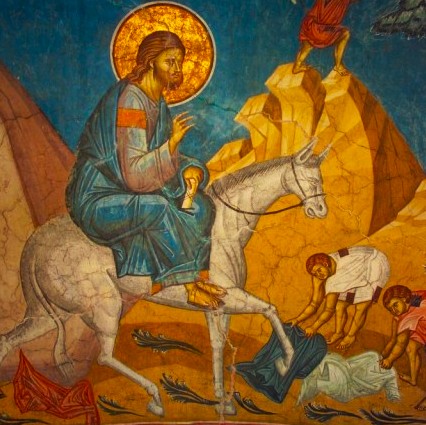
It’s funny how, when I turn to Matthew 21:1-11, the Gospel text for Palm Sunday, it’s Polyjuice Potion that comes to mind, specifically its ability to transform a person’s appearance. This is because the Gospel of Matthew, through its depiction of Jesus’ triumphal entry into Jerusalem, is very intentional to ensure Jesus takes on the appearance of a prophet. In verse 11, the crowds identify Jesus as “the prophet Jesus from Nazareth of Galilee.” None of the other Gospels include this detail. For Matthew, Jesus’s triumphal entry into Jerusalem is the living embodiment of the prophet Zechariah’s vision of the victorious yet humble king who comes to redeem Jerusalem (Zechariah 9:9). But, even more than this, the crowds who welcome Jesus to Jerusalem speak excitedly of him as a prophet.
Now, maybe if you’re a Bible nerd like me, it’s details like this that send you into a tailspin and make you want to crawl down numerous rabbit holes to understand more fully how Jesus is a prophet. However, I sense something even bigger at play: Matthew’s insistence that the crowds identify Jesus as a prophet challenges us to ask what is significant about Jesus to us.
Why does it matter to you and to those in your congregation that Jesus sets foot in Jerusalem? Or that he shares one final meal before his arrest with those closest to him? Why does it matter that he endures his passion and dies on the cross? Why does it matter that he’s resurrected? Who is he to you and to those who will listen to you preach?
The answers to these questions might seem obvious, but Holy Week takes on unique meaning to each of us amidst the circumstances of our lives and the state of the larger world in which we live. As followers of Jesus, we are called to enact faithful stewardship in each area of our lives. Our priorities will be determined by what we believe about Jesus’s identity and impact.
The thing is, although each of the four Gospels depict Jesus’s triumphal entry into Jerusalem, each puts their own spin on this moment, just as they each uniquely craft their accounts of Jesus’s life, ministry, and message. On Palm Sunday, the most significant week of the Christian year begins. We can use this opportunity to challenge ourselves and our congregants to do some soul-searching on what it is we hope for – what it is we need – as we follow Jesus during this most sacred of weeks.
In Worship
The word “hosanna” is, in a sense, synonymous with Palm Sunday. Matthew, Mark and John (but not Luke!) all depict the crowds shouting “hosanna” as Jesus arrives in Jerusalem. In our Palm Sunday worship services we often sing hymns featuring “hosanna,” and we include “hosanna” in other parts of the liturgy.
While we often say or sing “hosanna” joyfully, it’s actually a plea to “save us.” Ask your congregation what prompts them to plea with Jesus to save them. As is the case with the crowds in the Gospels who welcome Jesus in Jerusalem, who carry their own hopes and dreams of what his arrival means, we also hope and dream. Although many people might prefer to skip from Palm Sunday right to Easter, thus avoiding Jesus’s passion, crucifixion, and death altogether, Holy Week gives us the ability to experience our faith more deeply. What does it mean for Jesus, through the events of Holy Week, to save us?
Worship with Youth
Invite youth to picture themselves in the crowd that witnesses Jesus’s arrival in Jerusalem. What is the experience like? They can use their senses to imagine what the scene, from their vantage point, looks like, sounds like, and feels like. Then, invite them to imagine that the scene is playing itself out in the here and now. If Jesus were to arrive where they live, who would be in the crowd to welcome him? Why would they be there? What would they be hoping for? By using imagination, youth might be able to personalize the experience of Palm Sunday and apply it to their own lives and context.
Worship with Children
In many congregations, palms are distributed on Palm Sunday. I have often seen people fold these palms into the shape of a cross. (One member of my church enjoys doing this on Palm Sunday during the sermon.) A great way to teach kids about the meaning of Palm Sunday is to teach them how to make their palms into palm crosses. There are YouTube videos that show how to do this. Explain that when the crowds waved palms they shouted, “hosanna,” which means “save us.” And, several days later Jesus did this when he died on the cross and then was raised from death. Kids can keep their palm crosses throughout the week so they’re reminded of the palms’ significance.
Previous reflections for Palm Sunday (or Palm/Passion Sunday), Year A:
2020 – Raise your palms, people!
2017 – The Jesus parade
2014 – Like a broken vessel
2010 – After the parade



Leave a Reply