Lectionary Reflection for Christ the King Sunday, Year A
November 23, 2014
And the king will answer them, “Truly I tell you, just as you did it to one of the least of these who are members of my family, you did it to me.” Matthew 25:40
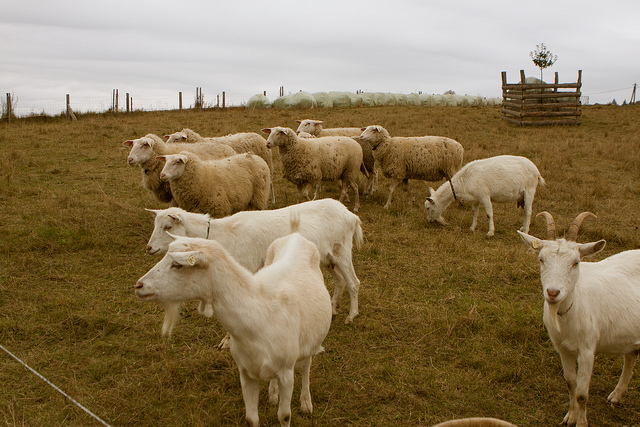
My first response when this lesson rolls around in the lectionary is always “But, wait a minute, I like goats!” And then I have to wrestle all over again with the mental tapes from my youth and early adulthood about sheep, goats, and this oh, so strange concept of Christ the King. Yep, I’ve spent far too much time pondering imagery of separating these two farm animals into the distinct categories of bound for eternal life or destined for eternal damnation. It’s a stark contrast of all or nothing–forever.
It finally occurred to me that maybe obsessing about the two animals wasn’t really the point of the story. For modern readers not familiar with a pastoral lifestyle or animal husbandry, sheep and 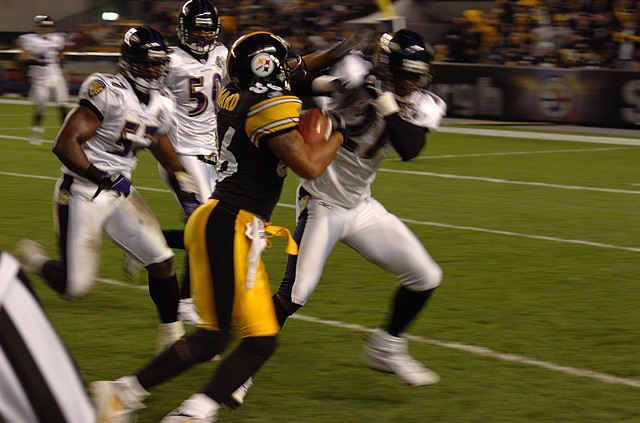 goats don’t necessarily mean much. Modern sports fans might make a better connection with a division of the Ravens and Steelers, whereas Broadway aficionados of Bernstein and Sondheim might relate more readily to the separation of the Sharks and Jets. The point is this: use any two common images that work for you, but remember the focus is on Jesus. It’s Christ the King Sunday after all.
Just who is this King of Everything? Who is this Jesus hanging out in the least, the lost, the poor, and the imprisoned? How were we supposed to know to look for God in the dark and dirty places of the world? We look for the winners, not the losers in life. Both “team goat” and “team sheep” express surprise at where Jesus was hiding in plain sight. He’d been right there with them in the midst of daily life in all its mundane messiness rather than holed up with the holy in the Temple or marooned on some majestic mountaintop. It’s not even in the recognition that Jesus is interested; he’s focused on action.
“Team goat” may have been all about keeping a watch out and being ready, but they totally overlooked the King of Everything around and within them. They were saving their big effort for the king who shows up looking and acting like royalty; in doing so they failed to see Jesus at all. “Team sheep” may have been looking for the king, but they weren’t sitting around chewing cud and rolling in the grass to kill time. They were busy taking care of neighbors in need and ministering to folks within and outside of their communities.
 Whether we see ourselves as sheep, goats, Broadway teenage gangs, or die-hard NFL fans, the King of Everything is interested in what we’re doing with our days and hours and with whom we’re in relationship and how that is expressed. If we’re simply hanging out with others who are just like us, doing as little as possible, wiling away the hours thinking about Christ’s second coming, it seems we likely have another “think” coming. By contrast, if we’re about living each moment to its fullest — in the business of cultivating relationships, tending to the needs of friend and neighbor (and enemy, too!), and wading into life’s most difficult places and situations with the light of Christ shining brighter than LED Christmas lights, then we’re definitely on the right track.
Jesus the King of Everything knows more than a little bit about humankind, about suffering, and about stewardship of all life. He took real life and our brokenness so seriously that he gave up everything in order to save every iota of creation. We do have a really strange King in Jesus the Christ, and that is a very, very good thing indeed.
In Worship
Could this be our prayer? Consider carefully Paul’s prayer for the church at Ephesus. Might we pray this prayer for one another? Could we challenge worshipers to find a translation or paraphrase of this prayer and pray it faithfully for the congregation all through Advent? Go to www.biblegateway.com to look at different versions such as the Common English Bible, The Message, or The Easy-to-Read Version. You could also write your own paraphrase. Emphasize the source of our power and God’s reconciling action in Christ as we daily live our our calling as disciples in the world.
With Youth
Consider contrasting and comparing the Old Testament reading from Ezekiel 34 with this week’s gospel lesson. Why might the lectionary authors have paired these two lessons on for Christ the King Sunday. There’s judgment aplenty and sheep and goats, but what’s the big picture connection, and what does that mean for us today? Invite youth to do a “mash-up” of the two passages using video, animation, or live drama.
With Children
Use Psalm 95:1-7a as an action praise prayer with children today. Use the Easy-to-Read version or write your own version and invite the children to act out the verses. They can bow, shout, sing, kneel, and praise. Consider putting each verse of action on a separate poster board. Keep it simple. End with “And all God’s children say AMEN.” If you play an instrument, consider turning this psalm into a simple song. Use a tune like “Jesus Loves Me” and modify the words:
Verse 1: Oh, come let us sing to the Lord/give our praise forevermore./God is great. God is our King./To God now we praises bring.
Chorus: Yes, let us worship. Yes, let us bow down. Yes, let us praise God. It’s good to give God praise.
Verse 2: God created earth and sky./Valleys low and mountains high./The sea is God’s and dry land, too./God made me and God made you.
(Photos: Jirka Matousek, SteelCityHobbies, and syracuse.com, Creative Commons)