

By the Rev. Robert Blezard
Revised Common Lectionary reflection, 4th Fourth Sunday after the Epiphany, Year A
February 1, 2026
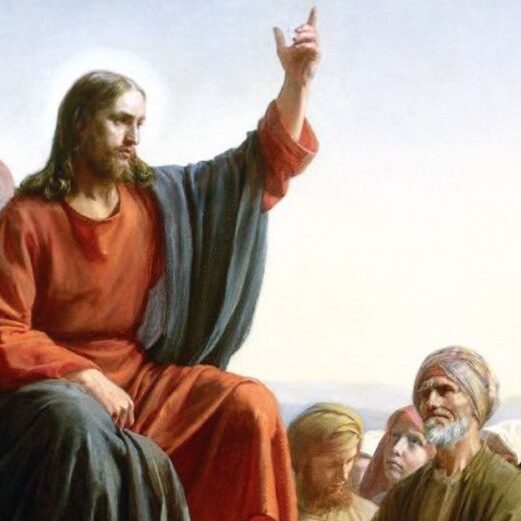
Key verse: When Jesus saw the crowds, he went up the mountain, and after he sat down, his disciples came to him. And he began to speak and taught them, saying: -Matthew 5:1,2
Followers of Jesus wrestle with these two central questions: Now that I am on the path of discipleship, how am I to live? And, Am I really living right?
These questions strike at the heart of how we steward not only our faith, but also our every thought, word, action, relationship, encounter and problem. The answers, of course, can be found throughout the Bible, but the passages assigned to this Lectionary Sunday bring them special clarity.
The Prophet Micah tackles the issues head on, pondering what God really wants from us. Micah’s musings direct us from the superficially external – that God might desire extravagant offerings – to the very interior of our hearts, where all our thoughts and motives originate. Not only is Micah’s message in 6:18 brilliant and simple, the prophet is clear that it is hardly new information for God’s people: “God has told you, O mortal, what is good, and what does the LORD require of you but to do justice and to love kindness and to walk humbly with your God.”
Those three imperatives, “do justice,” “love kindness” and “walk humbly with your God” speak to the core of who we are. If our heart is not set aright, we simply cannot and will not be able to accomplish those three tasks. They require us to do deep, prayerful introspection, asking God to reveal our true nature and to transform us into the people God wants us to be.
So, too, the “Beatitudes” – Jesus’ words that begin his familiar “Sermon on the Mount” – compel us to look deep into our souls to discover our true motivations, our weaknesses, our woundedness and our egoic desires. English-speaking Christians have long noted the play on words, casting the “Beatitudes” as the “be attitudes” for faithful living. It’s a catchy way to look at vv. 2-12, but deeper probing is fruitful.
Jesus’ “Sermon on the Mount” arises in a much different context than Micah’s message. Remember that last week’s Gospel reading told us Jesus’ first words as he began his public ministry: “Repent, for the Kingdom of Heaven has come near” (Matthew 4:17). God is doing a new thing. Just seven verses following that declaration, Jesus begins explaining all about the Kingdom of Heaven – the kind of people who are especially suited for entry and what is expected.
The “be attitudes” lead off the “Sermon,” which continues through Matthew 7. As enriching as they are, it would be a mistake to read vv. 1-12 in isolation. (For a deep dive into the Sermon, I recommend the Bible Project’s free 41-episode podcast series on just the Sermon on the Mount. It’s extensive, very insightful and worth every minute of listening. Click here to access the series.)
A good sermon could remind people of the key questions we ask as we steward our faith and our lives more generally. Micah’s and Jesus’ answers certainly fit well together, aiming as they do toward our deepest emotions and attitudes. But Jesus’ Beatitudes, especially, invite extensive thought, discussion and prayerful meditation. For example, just to take v. 2, we can ask “Who ARE the poor in spirit, and why is the Kingdom of Heaven THEIRS? No quick answers arise. And the follow-up questions require significant prayer and introspection: “To what degree am I poor in spirit? How can God help me?”
I the questions can be asked of each Beatitude. At the end, one can become more aware of the “be attitudes” that help us better steward our lives of faith and our lives in general. To become more fully the people God wants us to be and to have the lives God wants us to have.
In worship
This is the Sunday to search the church closets, basements and attics for banners that relate to the Beatitudes or to Micah’s simple three-point charge. Displayed around the worship space, the banners would provide support for a message calling for repentance and a change of heart. Don’t have such banners? Well, hand-made posters would get the message across. Your youth group or Bible study participants could make and post them.
To accompany a sermon, the church could prepare PowerPoint slides or a bulletin insert inviting discussion on Micah 6:18. Simply ask four questions of each point. For example, with “do justice”:
- What does it mean to “do justice”?
- How does anyone “do justice”?
- How well are you “doing justice”?
- How can you “do justice” better?
With youth
Asked to describe “the Kingdom of Heaven,” and too many Christians say it’s the place we go to when we die. While not entirely wrong, it’s woefully incomplete. Maybe in a Bible study, invite youth to look at Matthew 4:17 for clues about the Kingdom of Heaven. How is it “near”? Near in time? Near in space? How?
Then turn ahead eight verses to Matthew 5:2. Who are the poor in spirit and why is the Kingdom of Heaven theirs? Why does Jesus say the Kingdom of Heaven “IS” theirs, not “will be” theirs? What does this signal? Looking at the rest of the Beatitudes, what clues can be found about the mysterious “Kingdom of Heaven” and who is especially suited for it?
With children
During a children’s message or Sunday school, discuss with the youngest saints about why it’s important to be kind, as opposed to being mean. Invite them to explain what kindness is and ask them why Christians are taught to be kind. Encourage them to share ways that they can be kind to people they encounter – their family members, their schoolmates, their friends, etc.
Talk with the children about how God tells us through the prophet Micah that we should “love kindness.” Discuss with them what that means. End with prayer.
Previous reflections for Epiphany 4A:
2023 – Follow God’s script and discover what’s important
2020 – Holy fools in Christ
2017 – We are called
2014 – Consider your own call




Leave a Reply