Forgiveness ‘from the heart’ provides true freedom
By the Rev. Robert Blezard
Revised Common Lectionary reflection for the Sixteenth Sunday after Pentecost, Proper 19, Year A
September 13, 2026
Key verse: “[After he finished the parable, Jesus concluded:] “So my heavenly Father will also do to every one of you, if you do not forgive your brother or sister from your heart.” – Matthew 18:35
Years after his painful divorce, and even after he was remarried, “Chuck” remained bitter. Whenever the subject arose, his face souring and his voice becoming low and gravely, he would spit venom about his “cheatin’” ex-wife.”
In Chuck’s mind, holding the grudge wreaked sweet revenge and delivered due justice. But mostly it just kept his wound open and him stuck in the past. Withholding forgiveness harmed Chuck much more than his ex-wife.
Chuck’s story illustrates both the mystery and the paradox of forgiveness. While we channel our forgiveness towards those who have harmed us, often we are its primarily beneficiary. Forgiveness releases us from guilt, shame and pain –regardless of how it is received by those we forgive.
The power of forgiveness is a message sorely needed in our “don’t-get-mad, get-even” culture, where it’s normal – even expected – that we hold grudges and seek revenge. As a result, way too many people carry pain and grief that distorts their lives and spoils their peace of mind.
Perhaps that’s one way to make sense of Jesus’ warning following his Parable of the Unforgiving Servant, meant to explain to Peter how forgiveness works in “the kingdom of heaven” that Jesus is inaugurating.
In the parable, a king has forgiven a vast fortune owed by a servant who begged him for mercy, only to find out that that same servant then was harsh and uncompromising with someone who owed him a petty sum. After berating the unforgiving servant, the king ordered him tortured until the whole amount was satisfied.
Jesus then delivers a conclusion that surely can keep us up at night. “So my heavenly Father will also do to every one of you, if you do not forgive your brother or sister from your heart” (Matthew 18:35).
A thoughtful sermon could focus on the meaning of “forgiveness from your heart.” Certainly, we can say we forgive someone with our lips, and we can even deceive ourselves into thinking that we are done. But then those old wounds begin to ache and resentments bubble to the surface, and we relive the hurt all over again.
Now that’s torture, the kind that “Chuck” suffers, along most of us in some circumstances. Returning to the parable, we face that kind of torture “until the whole amount” is satisfied – that is, until we have fully forgiven “from the heart.”
Such forgiveness is not. To understand better, it’s worth exploring what forgiveness is not and what it is:
- Forgiveness IS NOT acting as if the abuse or harm never happened. Forgiving and forgetting do not always go together.
- It’s NOT opening oneself to continuing or future abuse or harm. We need to protect ourselves and our loved ones.
- It’s NOT necessarily resuming a relationship under the same terms as before the harm.
- It’s NOT forgoing consequences for the one who harmed us. An apology, restitution, compensation and even criminal or civil justice may still be appropriate.
By contrast:
- Forgiveness IS releasing ourselves from keeping a grudge or desiring revenge.
- It IS, correspondingly, freeing the other parties from our negative emotions. They will have to go on with their lives and learn their lessons without our shaming or guilting them.
- It IS seeking no more than fair restitution or justice for the wrongdoing. They may still have to face some consequences for their actions.
- It IS praying and expecting that God will heal our wounds, restore our lives and help us find joy.
- It IS praying and expecting that God will similarly work to mend and redirect the one who harmed us.
Forgiveness “from the heart” stops the “torture,” frees us from the past and opens us to the blessings God wants to pour into our lives here and now. Forgiveness “from the heart” is not easy, but it can be accomplished with God’s help.
For “Chuck” – and anyone struggling with grudges and unforgiveness – a good start is praying to God for strength and guidance. And wisdom. And perseverance. Full forgiveness “from the heart” can take time and lots of effort. But it’s worth it to experience the full life of abundance that Jesus promises to all who follow him.
In worship
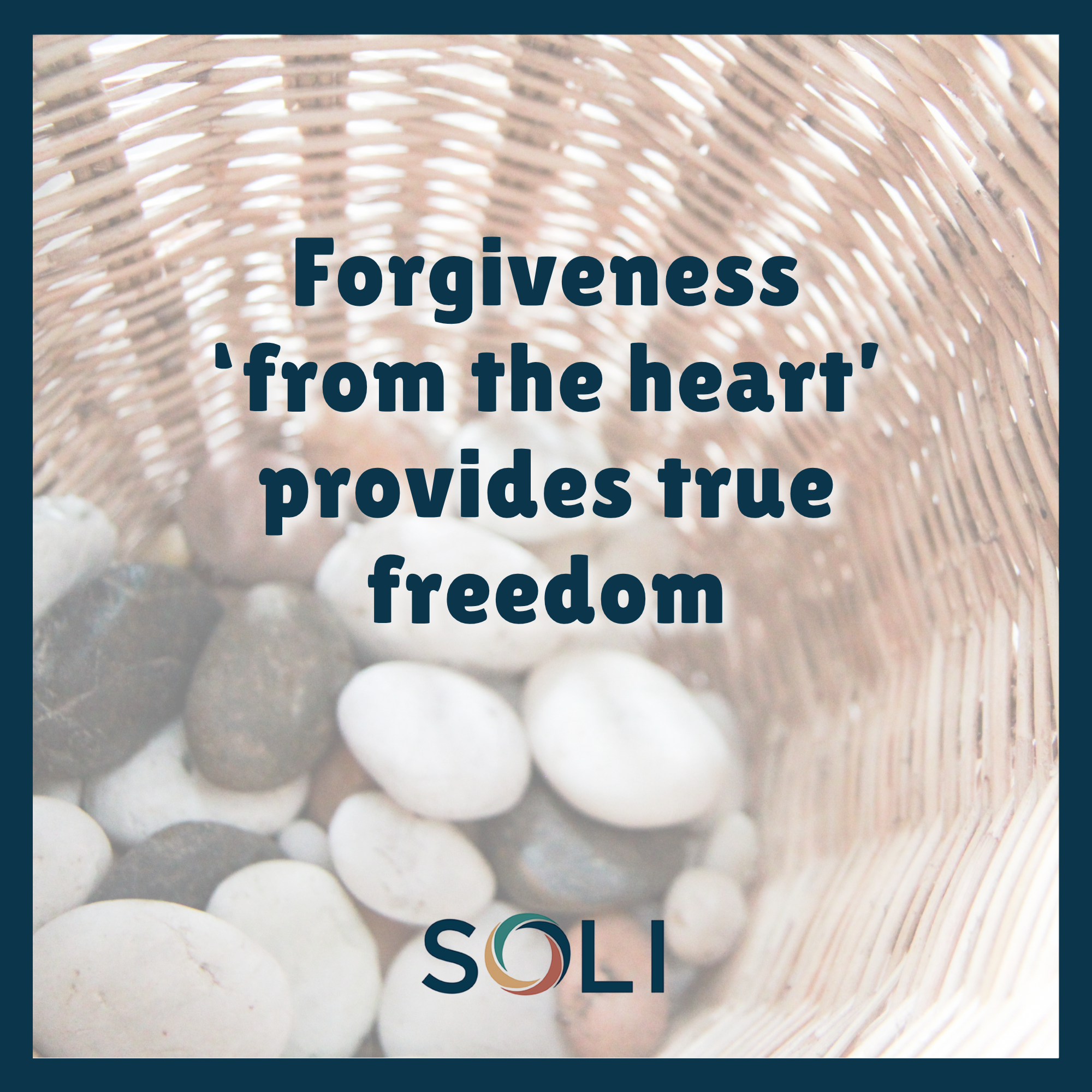
To illustrate the power of forgiveness, assemble a supply of small stones – you could find them or buy them from a garden-supply store. Provide one to congregants as they come to church. In pre-church announcements, or possibly in the sermon, tell congregants that the stone represents a wound or a grudge that they carry and that burdens them. It’s human nature that all of us carry a “bag of stones” because we find it hard to forgive from our heart.
After the sermon, provide a time when people can come forward and place the stone in a basket on or near the altar, symbolically giving the burden to God. End with a prayer.
With youth
The ability to “forgive from the heart,” as Jesus describes in Matthew 18:35 may come more with age and maturity, but youth certainly can understand the concepts. Teen age is often a troubled time for young people who are no longer children but not quite adults. As the rise of online bullying has revealed, many youth are targets of teasing and harassment.
In a confidential conversation with youth, ask them what kind of hurts they observe their peers in school. Some may offer their own experience of harm. Invite them to think of what forgiveness “from the heart” would look like? Review what forgiveness is and what it is not. End with prayers for healing and forgiveness.
With children
Even the youngest saints know about forgiveness. When they do something wrong, it’s their parents who give them the forgiveness “from the heart” that enables children to learn valuable lessons and be free from guilt and shame. Parents, too, let go of the incident.
Illustrate this dynamic using a case from your childhood or your experience as a parent of children. Doing something wrong is just human, and sometimes there are lessons and consequences, but the forgiveness a parent gives us means we don’t have to feel bad anymore. And our parents don’t hold it against us.
Close by talking about how God wants us to forgive others so both we and they can live with joy and peace.
Previously published reflections for Proper 19A:
2020- Bridge builders and faithful forgivers
2017- The Work of Forgiveness
2011- The mathematics of manumission = freedom in forgiveness