By the Rev. Micah Krey
Revised Common Lectionary reflection for the Twenty First Sunday after Pentecost, Proper 24, Year A
October 18, 2026
Key verse: “Give therefore to Caesar the things that are Caesar’s, and to God the things that are God’s.” – Matthew 22:21
“Is it lawful to pay taxes to the emperor, or not?”
The question posed to Jesus sounds straightforward, but Matthew tells us from the beginning that it is a trap. The Pharisees and Herodians are not looking for financial advice. They are trying to force Jesus into a choice that will get him in trouble no matter how he answers.
Jesus refuses the terms of the trap.
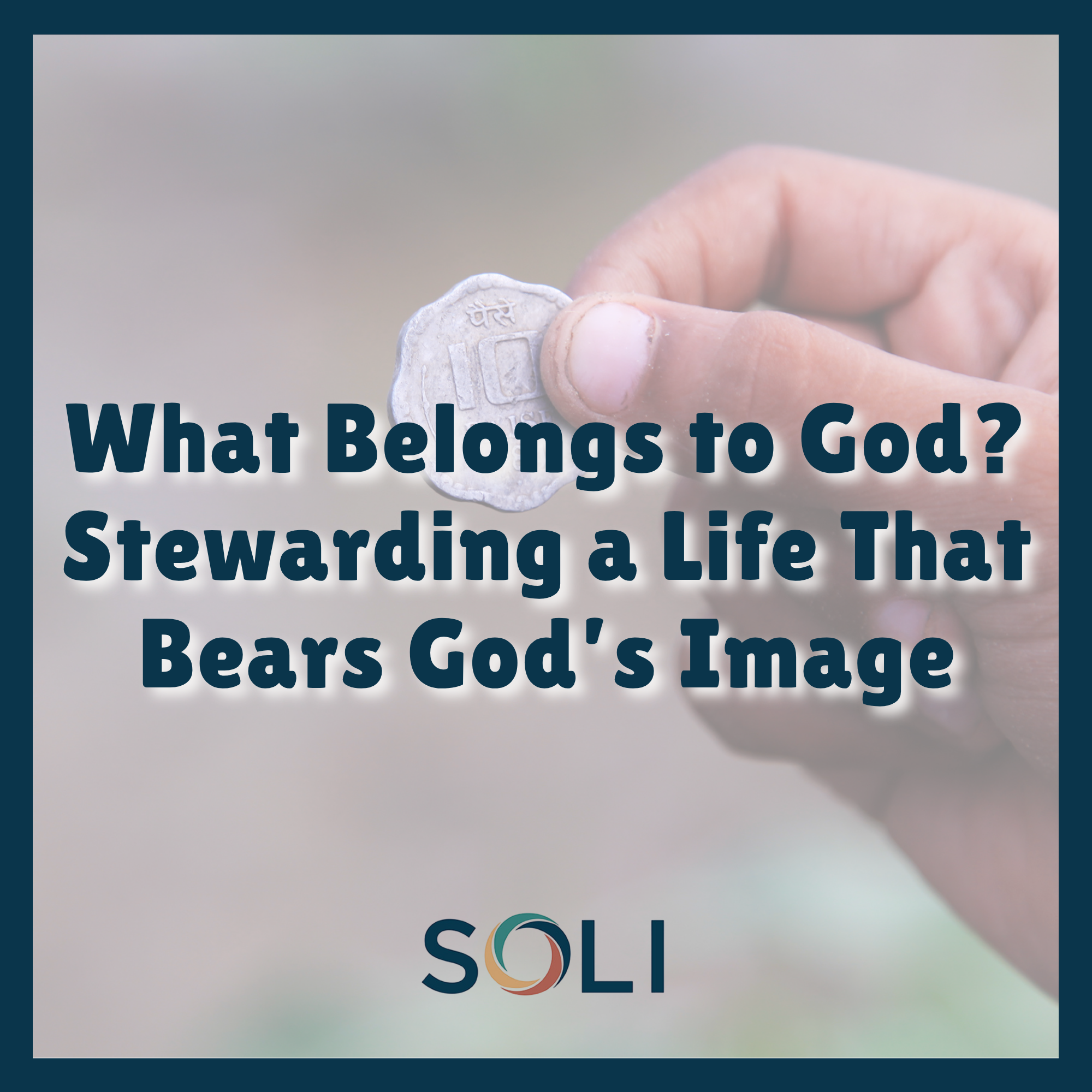
He asks for the coin used to pay the tax and then asks whose image and title it bears. “The emperor’s,” they answer. So Jesus responds with the familiar words: “Give therefore to Caesar the things that are Caesar’s, and to God the things that are God’s.”
For a stewardship reflection, it is tempting to stop with the first half of that sentence. We could talk about money, taxes, civic responsibility, and the faithful use of financial resources. But the second half is where the question becomes much larger: What belongs to God?
The coin bears Caesar’s image. Scripture tells us that human beings bear God’s image.
Suddenly, Jesus’ answer is not simply about deciding which portion belongs to the emperor and which portion belongs to God. The question reaches into the whole of our lives. If we bear God’s image, then our time, relationships, abilities, resources, decisions, and very selves are lived within God’s claim.
That is an important corrective to the way stewardship can sometimes be discussed in the church. We can easily reduce stewardship to deciding how much of “our” money we are willing to give to God. Jesus invites a deeper question. Rather than asking, “How much belongs to God?” we might ask, “How do I faithfully steward everything that has already been entrusted to me?”
Paul offers a picture of what such a life might look like in 1 Thessalonians. He gives thanks for the community’s “work of faith and labor of love and steadfastness of hope.” Faith, love, and hope are not merely ideas they believe. They have become visible in the way the Thessalonians live.
That is stewardship.
A work of faith asks how our choices reflect what we trust. A labor of love asks how our gifts are used for the sake of our neighbors. Steadfastness of hope asks whether fear or God’s promises have the final word in shaping our decisions.
Even Exodus 33 pushes toward this deeper understanding of belonging. Moses does not simply ask God for directions about where Israel should go next. Moses wants the assurance of God’s presence: “If your presence will not go, do not carry us up from here.” What distinguishes the people is not simply what they possess or accomplish, but whose presence shapes their life together.
As preachers, this text gives us an opportunity to move stewardship beyond the offering plate without leaving money behind. Our finances matter precisely because they are one part of a much larger life entrusted to us. So are our calendars, our homes, our influence, our attention, our vocations, and our relationships.
Jesus turns a question about a coin into a question about an entire life.
Perhaps faithful stewardship begins there. Not, “What portion of my life do I owe God?” but, “Since my whole life belongs to God, how might I faithfully use what has been entrusted to me?”
In Worship
This Sunday offers a natural opportunity to connect stewardship with baptismal identity. A coin carries the image of an earthly ruler, but worship reminds us of the deeper identity that shapes our lives: we belong to God.
Consider placing the baptismal font prominently or beginning worship with a thanksgiving for baptism. During the sermon or prayers, invite worshippers to consider the many things entrusted to them beyond money: time, relationships, abilities, influence, possessions, and opportunities to serve. The prayers might give thanks for these gifts while asking for wisdom to use them faithfully.
Hymns such as “Take My Life, That I May Be,” “God, Whose Giving Knows No Ending,” or “We Are Called” can reinforce the theme that stewardship involves the whole of life.
At the sending, consider a simple question for worshippers to carry with them: “What has God entrusted to you this week, and how will you use it in faith, love, and hope?”
Worship with Youth
Begin with a simple question: “What gets most of your time, attention, and energy?”
Invite youth to think beyond money. What occupies most of their day? What do they think about most? Where does their energy go? What drains their phone battery? Let the answers be playful at first before moving toward the deeper question of what those answers reveal about our priorities.
Then read Jesus’ words about giving to Caesar what belongs to Caesar and to God what belongs to God. Show them a coin and ask what identifies where it came from. The image stamped on it tells us something about whom it represents.
Then ask: “If your life belongs to God, what is stamped in the way you live your life?” What might someone see in the way you live that reflects God’s image?
Using Paul’s words from 1 Thessalonians, divide a page into three headings: faith, love, and hope. Invite youth to write one concrete action under each category that they could practice this week. Stewardship becomes more than what we give away. It is the way we use our whole lives to reflect who we belong to.
Worship with Children
Bring a coin and a small mirror.
Show the children the coin and ask what they notice. Point out the picture stamped on it. Explain that in Jesus’ time, coins also had the ruler’s picture on them. Jesus asked people to look at that image when they asked him a tricky question about money.
Then hold up the mirror and let several children look into it.
Ask, “Whose image do you see now?”
Explain that the Bible teaches that every person is created in God’s image. We do not have God’s picture stamped on us like a coin, but our lives can show God’s love through the way we care for others, share, forgive, help, and welcome.
Invite the children to look at their hands. Ask them to name something loving those hands can do this week: help clean up, make a card, share a toy, hug someone who is sad, or help a friend.
Close by reminding them: “Everything about you is a gift from God, and you can use who you are to share God’s love.”
Previously published reflections for Proper 24, Year A:
2023 – Questions: A central part of steward-discipleship
2020 – It all belongs to God
2017 – Belonging to God
2014 – Reframed by the Holy Other
2011 – American Idols